
To choose an SEO company in India, first write down your business goal. Then shortlist three agencies and check their real case studies. Ask for a written scope, give only read-only access during the audit, and keep ownership of your accounts. Walk away from anyone who guarantees a number one rank.
Your inbox already has three SEO offers this week. One promises page one in 30 days. Another says your website “is not listed on Google”. The third is suspiciously cheap. How do you pick one without losing six months?
This guide gives you a seven-point scorecard, a method to verify case studies, INR cost ranges and the questions to ask. I work at ROI Hunt, which is an SEO company, so I have a stake in this topic. I have kept the advice agency-neutral and named no competitor. In this guide, “SEO company” and “SEO agency” mean the same thing: a business you pay to improve your search visibility.
What does an SEO company actually do?
An SEO company improves your website so that the right people find it on Google and turn into enquiries or sales. The work covers technical fixes, page content, links, local listings and reporting. See our SEO company in India page for how one scope is laid out.

The main work areas are:
- Technical SEO: crawling, indexing, site speed and mobile use.
- On-page SEO: titles, headings, internal links and page content.
- Content: pages and articles that answer buyer questions.
- Links: earning mentions from relevant sites.
- Local SEO: Business Profile and city-level visibility.
- Reporting: leads, revenue and next steps.
What people think: “SEO means ranking for my brand name.” The reality is that buyers search for problems and products, not your company name. Good SEO brings in people who did not know you yet.
An SEO company cannot control Google VERIFY: Google updates its guidance pages). Google states that no one can guarantee a number one ranking (Google Search Central).
Do this now: Write one sentence on what a new visitor should do on your site. Every proposal must connect to that sentence.
How do I set my goal and budget before talking to agencies?
Start with the result you need, such as leads, orders or calls, not with rankings. Then fix a monthly budget range and the cities you sell in. Agencies give far better quotes when they get these three inputs.
Common mistake: asking “What will you do for Rs 30,000?” before knowing the goal. You then compare packages, not outcomes.
Two special cases:
- Online store: category and product pages need different work. Look for an ecommerce SEO company that can show store examples.
- Local buyers: if your customers sit in one city, read how agencies explain local work, for example on city pages such as SEO company in Delhi or SEO company in Noida.
Who should not hire yet: a small business with a simple site and no budget can fix basics itself first. Google has a page on deciding whether you need an SEO at all (Google Search Central).
Digital marketing consultant in Delhi
If you are in Delhi and want a local adviser you can meet, compare a digital marketing consultant in Delhi too. Use the same checks: written scope, a named person and accounts in your name.
Should I hire an agency, a freelancer or an in-house SEO?
Hire an agency when you need several skills at once. Hire a freelancer for one clear task. Hire in-house when SEO is core to your business and you can afford senior people.
| Option | Choose it if | Main risk |
| Agency | You need strategy, content, tech and reporting together | Junior staff may do the work after the sales call |
| Freelancer | You need one task, such as an audit or a content brief | One person is a single point of failure |
| In-house | SEO drives most of your revenue | Hiring is slow and tools add cost |
Decision rule: if you cannot name the person who will do your work, ask before you sign. For wider marketing needs, this checklist on choosing a digital marketing agency may help.
Digital marketing consultant in India
A digital marketing consultant is a fourth option. A consultant sets the plan and checks the work, while your team or another vendor does the execution. It suits you if you need direction across SEO, ads and content but not a full team. See our digital marketing consultant in India page, and ask any consultant for the same written scope you would ask an agency.
What is the seven-point scorecard for choosing an SEO company?
Score each agency from 0 to 5 on seven points, multiply by the weight, and compare totals. The weights below are my suggestion, not industry data. Change them to fit your goal.
| # | Check | Weight | A score of 5 looks like |
| 1 | Proof of results | 20 | Case studies with industry, period and numbers you can verify |
| 2 | Scope and process | 15 | Written deliverables for month 1, 2 and 3 |
| 3 | Reporting | 15 | Leads and revenue shown, not only rankings |
| 4 | Team | 10 | Named person who will work on your account |
| 5 | Fit | 15 | Experience with your industry, city or store type |
| 6 | Ownership and exit | 15 | Your accounts stay in your name; notice period is clear |
| 7 | Price against scope | 10 | Quote lists tasks, tools and what is excluded |
Total = (score ÷ 5 × weight), added across all seven rows. Maximum is 100.
Worked example (made-up numbers): Agency A scores 4, 3, 5, 4, 3, 5, 3 and gets 78. Agency B scores 5, 4, 2, 3, 4, 2, 5 and gets 72. B has the better proof but weak reporting and ownership terms, so A is the safer pick.
How to use it: score only after the audit call. Ignore the sales deck. If two agencies are within 5 points, decide on the team and the reporting.
How do I verify an SEO company’s case studies?
Ask for the client name, the period, the starting point and the metric source. Then check it yourself. A case study without these four items is a marketing page, not proof.
What people think: “More traffic means the SEO worked.” The reality is that traffic can rise while enquiries stay flat. Ask for leads or revenue from organic search.
Use this five-step test:
- Ask which metric moved: organic leads, orders or revenue, not only traffic.
- Ask for the period and the baseline before work began.
- Ask for a screenshot from Search Console or GA4, with the client’s permission.
- Call one past client. Google suggests asking references whether the SEO was useful and easy to work with (Google Search Central).
- Search the client’s site on Google and see if the pages mentioned actually appear.
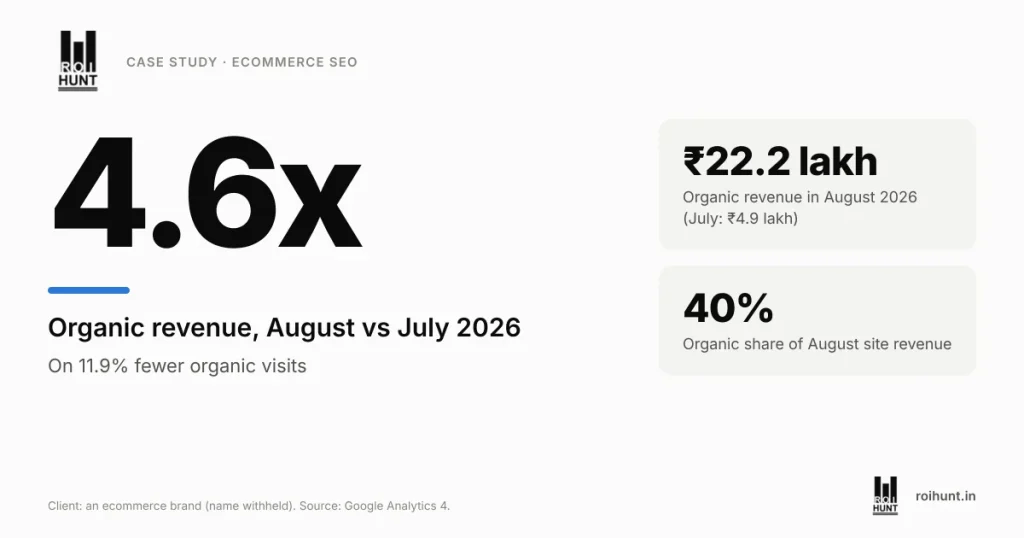
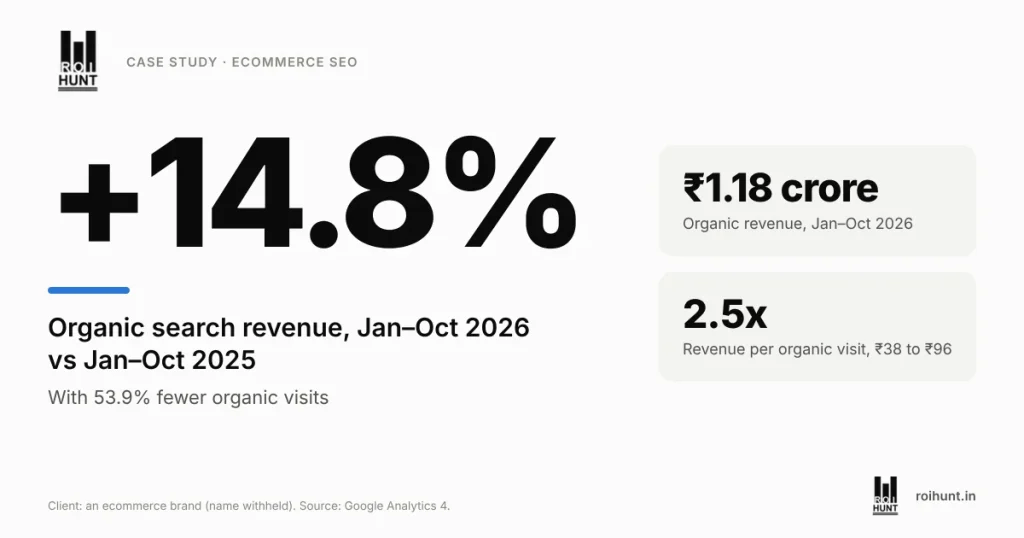
Example of a good format: ROI Hunt’s SEO case study states industry, period, challenge and result metrics.
What should I get in the first 90 days?
In the first 90 days you should get an audit, tracking set-up, a keyword map and the first fixes, with a report that compares your numbers to the starting point. No honest agency promises a rank in 90 days.
| Period | What you should see |
| Days 1 to 30 | Read-only access, audit, Search Console and GA4 check, conversion tracking, keyword-to-page map |
| Days 31 to 60 | Priority technical fixes, rewrites of your money pages, a content plan |
| Days 61 to 90 | New content live, a link plan, first report against the baseline |
This is a reasonable template, not a rule. A large store needs more time on technical work than a ten-page service site.
Ask this on the first call: “What will I receive at the end of month 1?” A clear answer shows a real process. Google also advises asking what results to expect, when, and how success is measured (Google Search Central).
How much does SEO cost in India?
SEO cost in India depends on site size, competition and scope. One agency’s published ranges run from about Rs 8,000 to Rs 20,000 a month for single-location local SEO up to Rs 1,50,000 to Rs 3,00,000 or more for enterprise work (upgrowth.in)
| Scope (per month) | Range shown by that agency |
| Single-location local SEO | Rs 8,000 to Rs 20,000 |
| SMB or early-stage growth SEO | Rs 25,000 to Rs 75,000 |
| Funded startup or mid-market brand | Rs 80,000 to Rs 1,50,000 |
| Enterprise, multi-region | Rs 1,50,000 to Rs 3,00,000+ |
| Freelancer | Rs 8,000 to Rs 40,000 |
Treat that table as one vendor’s view, not an industry average. Two other Indian agency pages show different floors:
| Source | Published | What it says about monthly price |
| mediaofficers.com | 15 July 2026 | Rs 25,000 to Rs 85,000 for most SMB needs; local-only from about Rs 15,000 to Rs 25,000; under Rs 10,000 is a warning sign |
| seorevive.in | 19 April 2026 | Minimum working budget of Rs 12,000; under Rs 8,000 is a warning sign |
The pages disagree even on what counts as too cheap. A price one page lists as normal local SEO, another calls a warning sign. So judge a quote by its task list, not by a benchmark. Clutch shows agency rates as hourly dollar bands, not INR.
Costs outside the retainer, from the same page: tools (Rs 5,000 to Rs 15,000 a month), content (Rs 2,500 to Rs 8,000 per 1,000-word article), a one-time audit or onboarding fee (Rs 15,000 to Rs 50,000).
Google policy page, updated 28 August 2026). The same page lists a price per link. Google’s spam policy names buying links to rank as link spam. Ask what “link acquisition” means in your quote. Also ask if the quote includes GST.
Common mistake: picking the lowest monthly plan. Check the task list, not the fee.
What questions should I ask an SEO company before hiring?
Ask questions that force specific answers. A good agency answers in plain words and shows examples. Here are ten:
- Who will work on my account, and who is my single contact?
- Can I see three case studies close to my industry?
- What will I receive at the end of month 1, 2 and 3?
- Which metrics will you report: leads, revenue or only rankings?
- How do you build links, and can you show examples?
- What work is not included in this price?
- Will my Search Console, GA4 and Business Profile stay in my name?
- How do you use AI tools for content, and who reviews it?
- What happens after a Google update or a ranking drop?
- What is the notice period, and what do I get when we part?
Decision rule: note how each agency handles question 6. Honest agencies list exclusions. Vague ones say “everything”.
Which SEO terms should a good agency explain in plain words?
A good agency explains each term below in one or two simple sentences and tells you what it will do about it. If the answers are vague, the work probably is too.
| Term | What it means | What to ask |
| E-E-A-T | Experience, expertise, authoritativeness and trust. Google says trust matters most and that E-E-A-T is not a ranking factor by itself (Google Search Central, page updated 5 October 2026). | Who writes our content, and can readers see an author bio? |
| Core Web Vitals | Three page-experience metrics: loading (LCP, good at 2.5 seconds or less), responsiveness (INP, under 200 milliseconds) and layout shift (CLS, below 0.1). | Will you report these from real-user data? |
| Structured data (schema) | Code that labels page content for Google. It can make a page eligible for rich results but does not guarantee them, and it must match what users see. | Which pages get schema, and why? |
| Search intent | The reason behind a search: to learn, compare or buy. | Which intent does each page target? |
| White-hat and black-hat SEO | White-hat follows Google Search Essentials. Black-hat tries to trick search engines, for example with bought links or hidden text. | Which tactics do you refuse to use? |
What are the red flags of a bad SEO agency?
The biggest red flags are a guaranteed number one rank, claims of a special link to Google, and secrecy about methods. Google lists these as warning signs (Google Search Central).
- Guarantees. Promises of top placement. Google says to look elsewhere.
- “Special relationship with Google”. Google calls for scepticism about this and “priority submit” offers.
- Cold emails. Messages saying your site is not listed on Google deserve caution; Google flags unsolicited SEO emails.
- Link counts. A fixed number of backlinks every month points to link schemes. Learn how link building should work before you agree.
- Mass AI content. Google’s spam policy describes scaled content abuse as many pages made mainly to rank, however they are produced.
- Rankings-only reports. If leads and revenue are missing, the report hides the result.
- Lock-in. Long contracts with no exit clause.
Green flags are the reverse: named team, written scope and readable reports.
What most people miss: you stay responsible for what the company does on your site. Google says deceptive content added for you can get your site removed from its index.
How do I check SEO company reviews in India, and which is the best SEO company?
Check reviews in three places: Google Business Profile, a review directory, and a direct call to a past client. Then match what you read with the agency’s case studies.
Know what each directory shows. Clutch’s India SEO list says it verifies reviews, shows rates as hourly dollar bands and notes that some listings are sponsored or featured. GoodFirms’ India SEO list says its client reviews are vetted by researchers, but the page does not show how each review was checked. Read the review text, not only the badge.
Spot weak reviews with these signs:
- Many five-star reviews posted in the same week.
- Generic praise with no project detail.
- Reviewer profiles with only one review.
- A star rating shown on the agency’s site but no link to the source.
Which is the best SEO company in India? No single agency is best for every business. The best choice is the one that scores highest on your scorecard for your goal and city. Be careful with “best SEO company” lists. On some pages I opened, the “best agencies in India” section named only the page owner’s own company. To test the method, score our own SEO company in India page like any other, and note what proof it shows.
If your own reviews are weak, fix that too. See online reputation management for what that work covers.
Should I hire an SEO company for AEO, GEO or AI search?
Hire for AI search only if the agency also does the basics well, because Google says AI Overviews and AI Mode have no special requirements beyond normal SEO.
AEO means answer engine optimisation, and GEO means generative engine optimisation. Both are labels for making content easy for AI tools to read and quote. Google also says site owners do not need new machine-readable files, AI text files or special markup for these features.
Use this four-question test:
- What exactly will you change on my site for AI search?
- Can you promise citations in ChatGPT or Google? (A good answer is no.)
- Which of these steps would also help normal Google search?
- How will you measure it, and what is the baseline?
Red flag: selling a file or a markup as a shortcut. No tactic guarantees AI citations or rankings.
What should an SEO contract include?
A good SEO contract states the scope, reporting, ownership and exit terms in writing. This is a checklist, not legal advice. Have a lawyer or CA review the final contract.
- Scope: the tasks per month and what is excluded.
- Access: read-only for audits; write access only after you sign, and only what is needed. Google advises read-only Search Console access at the audit stage.
- Ownership: Search Console, GA4, Business Profile, domain and hosting stay in your name.
- Content and links: you own the content; the agency lists the links it builds.
- Reporting: monthly report and a review call.
- Notice period: month-to-month or short notice, with handover of all files and logins.
- Methods: a promise to follow Google Search Essentials.
Choose the shorter commitment if you are unsure.
Frequently Asked Question
Set a goal and budget, shortlist three agencies, and score each on proof, scope, reporting, team, fit, ownership and price. case studies and call one past client. Reject guarantees. Sign only after the scope and exit terms are in writing.
Look for case studies with Indian industries, reports in your language and time zone, and clear INR quotes that state GST treatment. Ask who works on your account. Location matters less than proof and process, since much SEO work can be done remotely.
No. Google says no one can guarantee a number one ranking. An agency that promises it is often choosing keywords nobody searches or using risky tactics. Ask which keywords, in which city and by when, and get the answer in writing before you sign anything.
For an audit, give read-only access to Search Console, as Google advises. After you sign, give only the access needed for the agreed work. Keep the accounts in your own name so you can remove access when the contract ends.
It depends on competition, site health and content. Ask the agency for a written estimate of what to expect and when, and how success will be measured. Distrust fixed promises. Review your baseline report after the first 90 days, then compare each month’s leads and revenue against it, not only rankings.
It depends on scope. Three Indian agency pages published in 2026 show local SEO from about Rs 8,000 to Rs 25,000 a month, and wider SMB work up to Rs 75,000 to Rs 85,000. Compare the task list, tools and exclusions, not only the fee. Prices change, so verify before you budget.
You can handle basics yourself if your site is small and you have time to learn. Hire help when growth needs more skill or hours than you have, or when technical problems block your pages. Start with an audit before you commit to a long retainer.
Conclusion: your next step
Before you call any agency, copy the seven-point scorecard into a sheet and write your goal at the top. Then book audit calls with three agencies and score each one only after the call. If you want a second opinion on a proposal, you can talk to ROI Hunt.